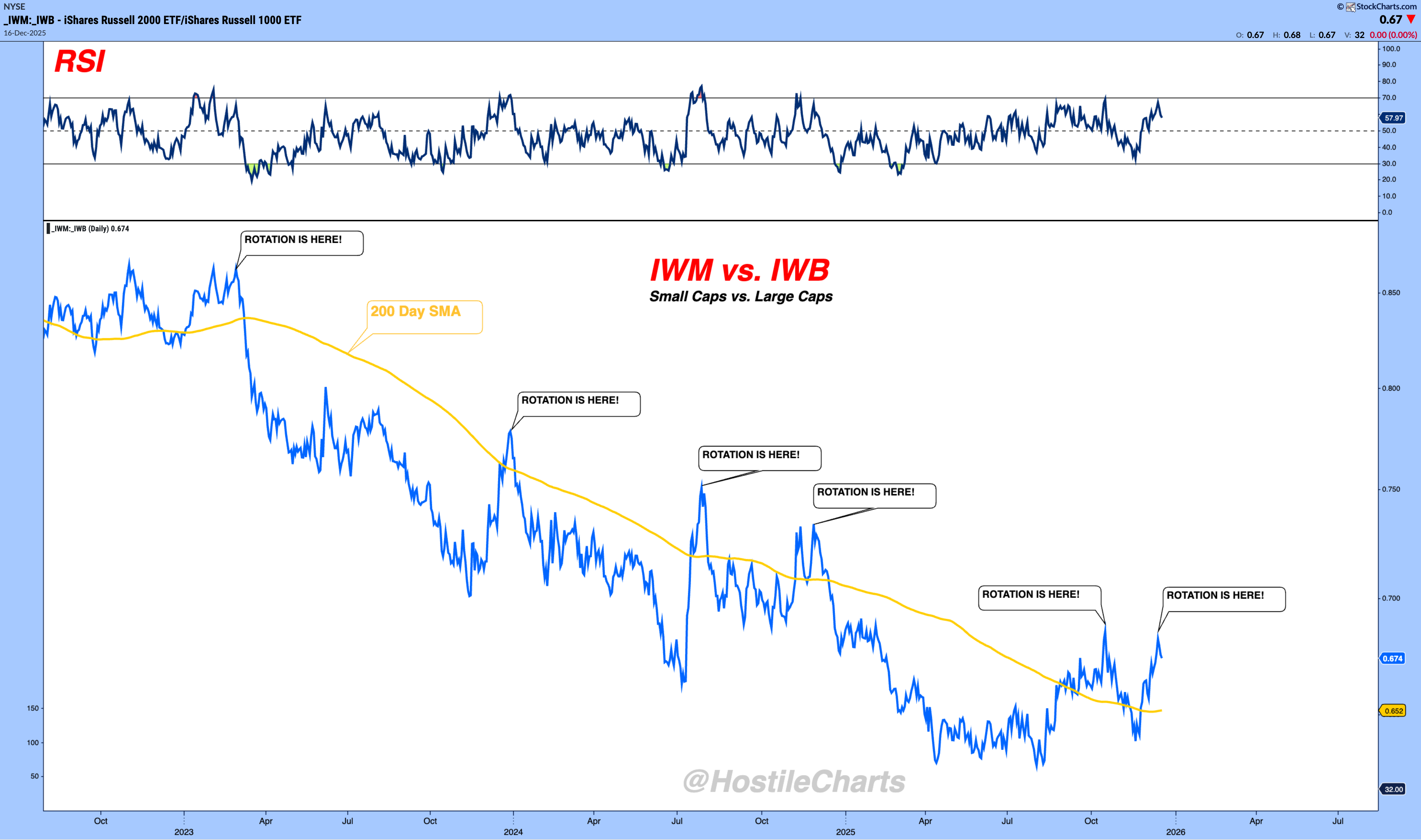
Rotation is Here Just Kidding..... By Larry Thompson December 16, 2025 Everyone loves a good underdog story. I get it.But the obsession with small caps “finally taking over” every time they outperform for a few days still blows my mind.Two or three times a year, small caps catch a bid.Large caps wobble a bit.And suddenly the narrative machine goes into overdrive.“The Broadening our is here.”“Leadership is rotating.”“This time is different.”Most of the time, it isn’t.The chart I’m sharing is one I’ve posted before for a reason. It’s not flashy. It’s not exciting. But it’s honest. This is the IWM vs. IWB ratio.IWM represents the Russell 2000, small-cap stocksIWB represents the Russell 1000, large-cap stocksTogether, they form the Russell 3000, which covers more than 90% of the U.S. equity market by market cap. In other words, this ratio is a clean way to measure whether capital is favoring small caps or large caps over time.And over time is the key phrase.When you zoom out, what you see is a persistent, long-term trend favoring large caps. Along the way, you’ll notice plenty of sharp countertrend moves. Those are the moments that spark the headlines and the hot takes. They feel important in real time, but most of them fade just as quickly as they appear.That’s the part that gets overanalyzed.Yes, everyone wants broad participation.Yes, everyone wants small caps to lead.Yes, that would be a healthy backdrop for the market.But wanting something doesn’t make it true.Until this ratio actually changes character, meaning sustained higher highs, higher lows, and a break in the long-term trend, there’s no urgency. No rush. No reason to abandon what’s been working.For now, large caps are still where capital has shown the most consistency. These are companies with scale, pricing power, global reach, strong balance sheets, and a proven ability to return capital to shareholders. They employ the best talent in the world and continue to drive the S&P 500.If the trend eventually changes, we’ll see it.And when it does, it won’t require a narrative. The chart will do the talking.Until then, most of these “rotation is here” moments are just another story to write.Anyway, that’s my two cents. Thompson's Two Cents Larry Thompson delivers timeless trading lessons and market wisdom in quick daily notes. More from Thompson's Two Cents Larry Thompson Following The Meatheads The Drugs Work.... June 16, 2026 Larry Thompson The Sunday Stalk List | Ep.46 Solving Problems May 31, 2026 Larry Thompson You Don't Own Enough Energy Fix It May 19, 2026 Trade Smarter With Larry’s TakeThompson’s Two Cents offers concise market wisdom, timeless trading lessons, and chart-driven perspective you can trust. You must have JavaScript enabled to use this form. Email More from Thompson's Two Cents Thompson's Two Cents Watch Now