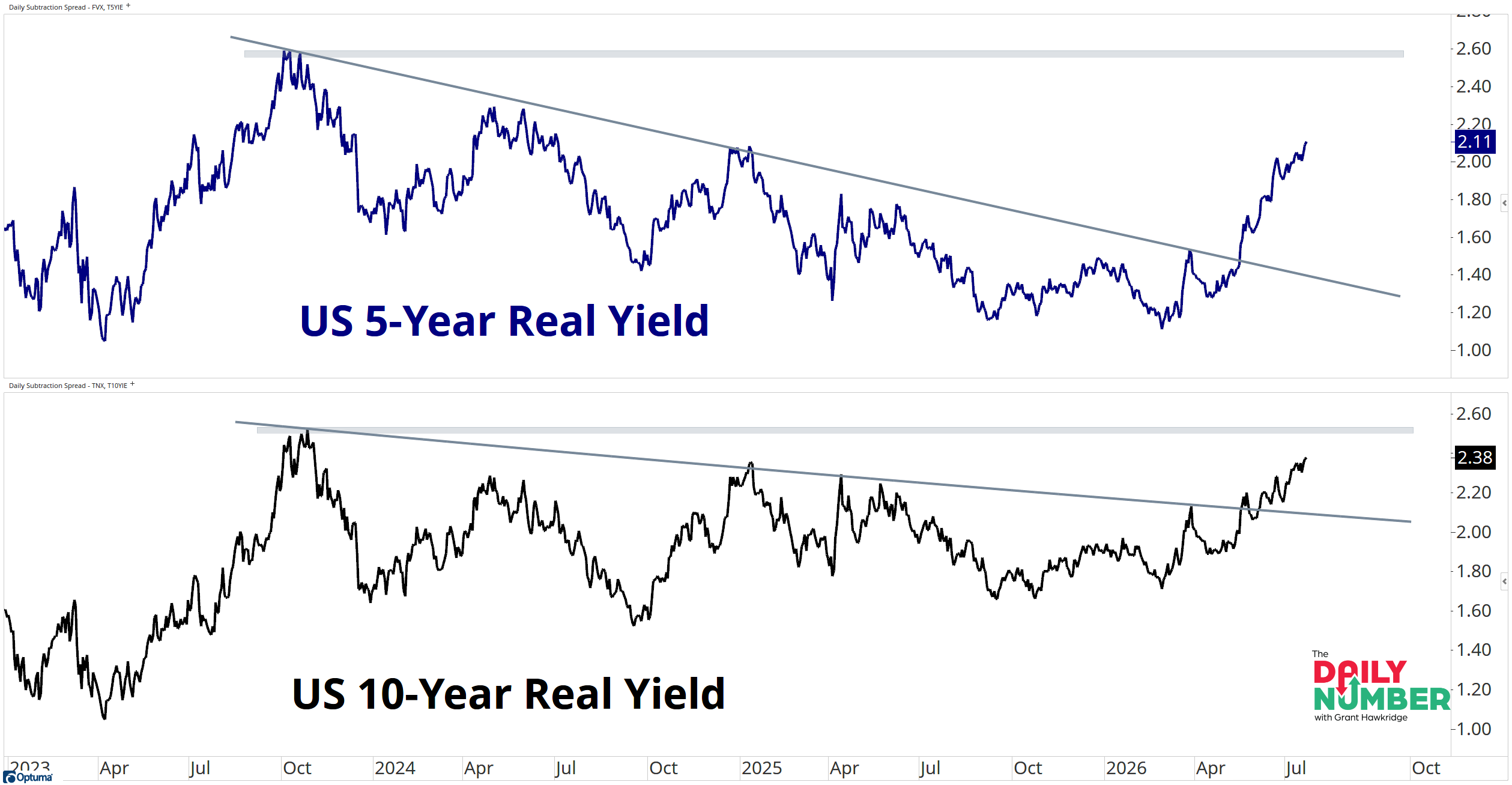
That means investors can earn around 2.4% above inflation by owning 10-year US government bonds. When that number rises, bonds become more attractive, and stocks have to compete harder for money.
Here’s the chart:
Let's break down what the chart shows:
The blue line in the top panel shows the US 5-year real yield.
The black line in the lower panel shows the US 10-year real yield.
The Takeaway: Bonds are starting to pay investors more again.
Not just more before inflation. More after inflation.
That is the simple message in this chart. The 5-year real yield is back near 2.1%. The 10-year real yield is back near 2.4%. Investors can now earn a real return across two important parts of the bond market.
The 5-year real yield gives us a read on the nearer-term cost of money. The 10-year real yield gives us a read on the longer-term cost of money. When both are breaking higher together, it is harder to dismiss the move as noise.
And that changes the conversation for stocks.
When bonds pay very little after inflation, investors are more willing to take risk in the stock market. They pay up for growth. They chase bigger stories. They are more forgiving when companies disappoint.
But when bonds start paying a better return, investors have another choice.
They do not have to chase every stock. They do not have to pay any price for growth. They can sit in bonds and still earn a real return after inflation. That means stocks need to give investors a better reason to own them.
That does not mean stocks have to fall.
It means the bar is higher. Strong stocks can still work. Companies with real earnings can still attract money. But expensive stocks, weak stocks, and story stocks get less room for mistakes.
So I am watching both lines.
One real yield breaking higher would be enough to get my attention. Both breaking higher makes the message harder to ignore.