As the AI panic wave crushes sector after sector, it's long past time to cut through the noise and figure out which companies are best positioned to see their businesses, profits, and, by logical extension, stocks improve through smart application of AI and its offshoots.
The answer is right in front of us, dominating for the last year and kicking the crap out of the other *major* players in its space; the Bentonville Behemoths themselves, Walmart.
While the rest of retail has seen the online experience improve dramatically over the last five years (what specialty chain doesn’t have a kick-ass app at this point?), discount has remained largely the same. You type a product in the search bar, and Amazon or Walmart kicks back 50,000 different options. It's overwhelming, inefficient, and baffling. Walmart and Amazon carry over a million products online and offline. At this point, I've had Amazon spy software (Alexa speakers) in my house for nearly a decade.
If a company has tech that can find my lost dog, why can't it reliably suggest something like a simple lightbulb for my desk lamp without giving me 10,000 options?
That's about to change. Walmart is leading the charge to revamp the entire discount shopping experience. If they do it right, and Wall St seems to think they will, it's going to change the way people shop and improve Walmart operations from the back end to the checkout.
When you move $700b in product a year, a little margin improvement goes a long way.
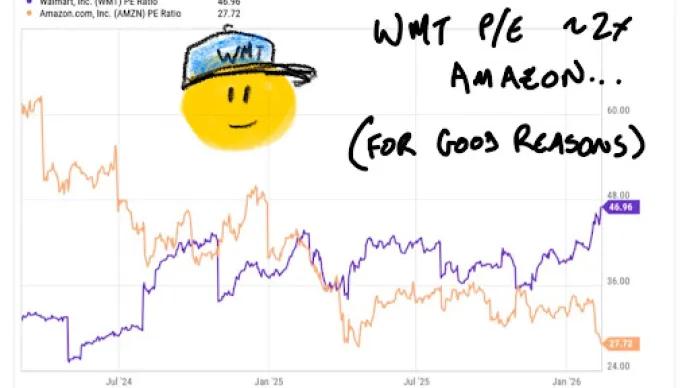
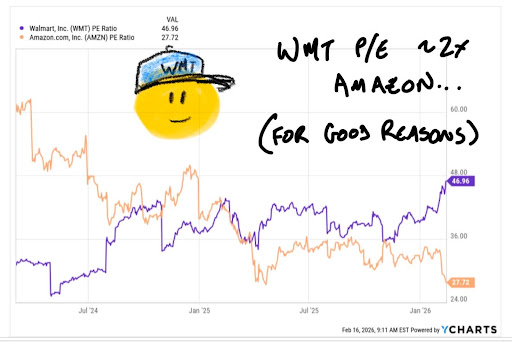
In other words, there's a reason Walmart shares are more expensive than Amazons for the first time in memory… Walmart is a better tech company than Amazon at the moment.
Let's break it down. As the AI panic wave crushes sector after sector, it is time to cut through the noise and identify which companies are best positioned to see their businesses, profits, and, by logical extension, stocks improve through the smart application of AI.
The answer is the discount retail leader dominating the sector: Walmart.
While the rest of retail has seen the online experience improve dramatically over the last five years, the deep discount experience has remained largely the same. A simple product search on Amazon or Walmart kicks back tens of thousands of options—a process that is overwhelming, inefficient, and baffling. With over a million products carried on and offline, the simple reality is: If a company has tech that can find my lost dog, why can't it reliably suggest a simple lightbulb for my desk lamp without giving me 10,000 options?
That inefficiency is about to change. Walmart is leading the charge to revamp the entire discount shopping experience. If they execute correctly, it will change the way people shop and significantly improve Walmart's operations from the back end to the checkout.
The 100-Basis Point Lever: Why Walmart is an AI Stock in Disguise
In the world of retail, a 1% shift is usually considered a rounding error. But at Walmart’s scale—with revenues marching toward $700 billion—that single percentage point (100 basis points) is a financial sledgehammer. As of February 2026, Walmart is no longer just a "big box" play; it has evolved into a case study for operating leverage fueled by two distinct AI engines: Agentic Commerce on the front end and a Self-Healing Supply Chain on the back.
The EPS Multiplier
For an asset manager, the Walmart thesis is simple math. As we move through Q1 2026, Walmart is trading at a premium P/E ratio of roughly 46x. Investors are paying up because they finally see the path to higher net margins. Historically, Walmart lived in the 2% range. Today, it has pushed past 3.3%, with sights set on 3.5% or higher.
If Walmart captures just 100 basis points (1%) of additional net margin through AI-driven efficiencies, it adds roughly $7 billion to the bottom line. Against its ~8 billion shares, that is an extra $0.88 in Earnings Per Share (EPS). In a stock currently projected to earn around $2.60 per share, a $0.88 boost represents a 34% growth explosion. When you apply a 40x multiple to that extra dollar of earnings, you aren't just looking at a better retailer; you're looking at a massive stock price rerating.
Front-End: The "Agentic" Conversion
The "Agentic Commerce" model—led by AI assistants like Sparky—is the ultimate margin protector. By moving from a "search bar" (where customers browse 500 million items and often leave) to a "conversational agent" (where the AI builds the basket for you), Walmart is solving the friction of choice.
For a customer in Encinitas ordering gluten-free essentials, the AI doesn't just "find" the product; it anticipates the replenishment cycle. This shifts the business from unpredictable retail to predictable subscription-like revenue. Every time an AI agent successfully "auto-fills" a cart, the Customer Acquisition Cost (CAC) drops to zero, and the margin on that basket expands.
Back-End: The Self-Healing Margin
The real magic, however, happens in the dark. Walmart’s supply chain is being re-engineered into a "self-healing" network. By early 2026, over 65% of Walmart’s stores will be serviced by automated fulfillment centers.
Inventory Precision: AI agents on the supply side talk to customer agents. If 10,000 households are about to run out of detergent, the "Self-Healing Inventory" reroutes stock before the shelf even looks empty.
Labor Efficiency: Automation reduces the cost to serve. When a robot picks a "store-fulfilled" order in three minutes instead of an associate walking the aisles for twenty, that 100bps margin improvement starts to look conservative.
The Valuation Inflection
We are witnessing the "Amazon-ification" of Walmart’s P&L. By layering high-margin Walmart Connect advertising (which grew 33% recently) and Walmart+ membership fees on top of an AI-optimized supply chain, the company is decoupling profit growth from headcount.
For the first time in a decade, Walmart’s earnings are growing significantly faster than its sales. In 2026, the market is realizing that Walmart isn't just selling more milk—it's using AI to earn more on every gallon. For investors, that 100-basis-point shift isn't just a goal; it's the catalyst for a new era of earnings power that could define the retail landscape for the next decade.