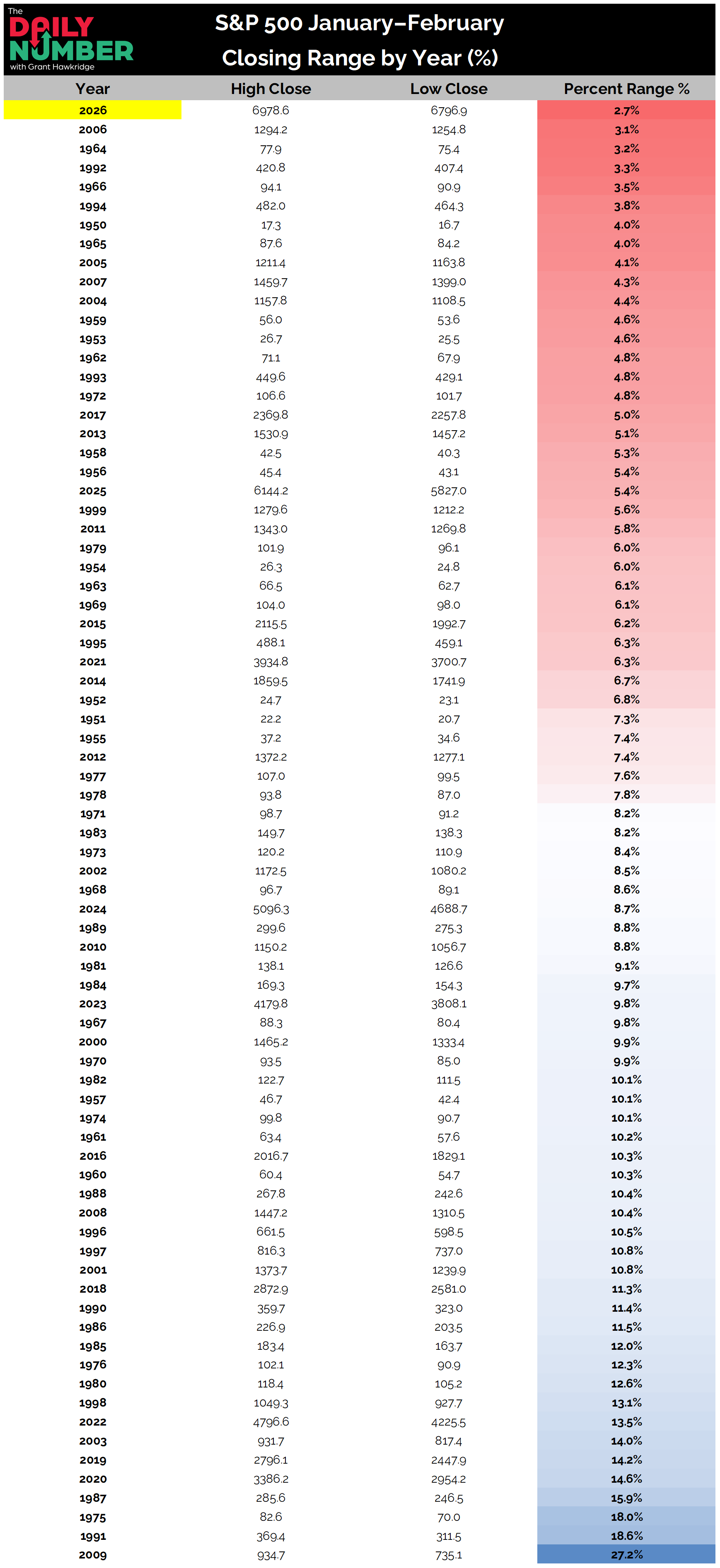
The S&P 500 has moved just 2.7% between its highest and lowest closing prices during January and February this year.
Here’s the table:
Let's break down what the table shows:
The table displays the S&P 500 January–February closing ranges by year.
The first column lists the year.
The second column lists the highest closing price recorded during January and February for that year.
The third column lists the lowest closing price recorded during January and February for that year.
The fourth column lists the percentage range between the highest and lowest closing prices.
The Takeaway: The S&P 500 has started 2026 with the tightest two-month trading range going back to 1950.
The index has moved just 2.7% between its highest and lowest closes during January and February. No other year in the table has been that quiet.
The next closest year is 2006 with a 3.1% range. Several other years cluster between 3% and 4%. Nothing else breaks below 3%.
The market has spent two straight months holding near the highs while volatility stays compressed. Headlines have been very loud, but price has barely moved.
The typical start to a year is much wider. The median January–February range across all years in the table is 8.2%. That level marks the midpoint of the dataset. Half of all years start tighter than that. Half start wider.
When the first two months come in below the median range, the year delivers a median return of 11.6%. When the early range expands above that level, the median return rises to 14.6%. Quiet starts still produce gains. But the bigger years usually begin with more movement than this.
Price has barely left the highs, and the market keeps holding its ground as time passes. So, what happens when this range finally breaks?